


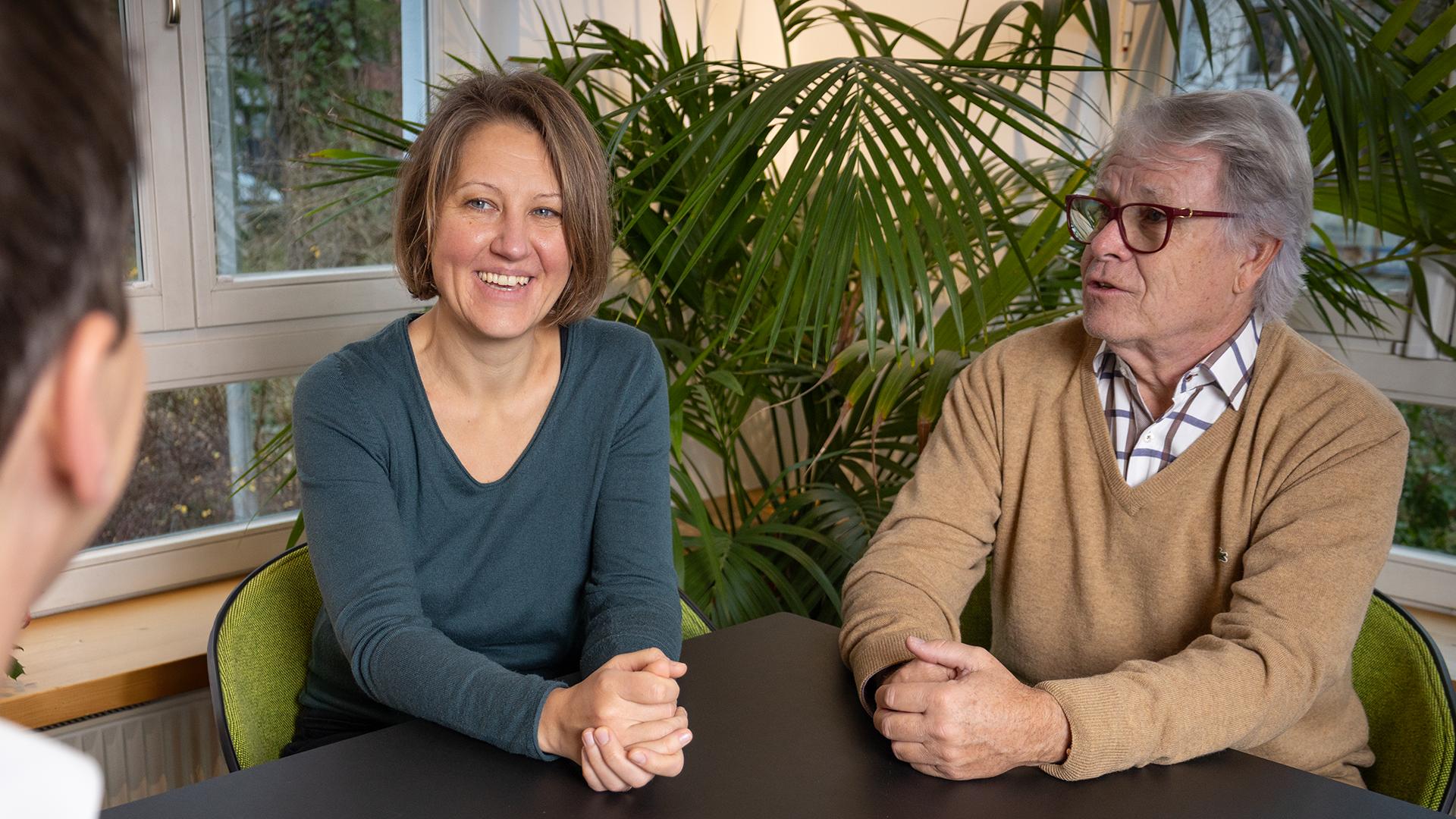


For the management of Projekt-Consult, the turn of the year also marks a generational change. Thomas Hentschel has been working for the consulting firm, which is part of the GFA GROUP and focuses on responsible raw material extraction, since the late 1980s. He is now stepping down as Managing Director. Johanna Carstens is taking over as authorised signatory in the company’s management and will lead it into the future together with Managing Director Moritz Lörcher. In this interview, we talk to Johanna and Thomas about their reflections and outlooks, their assessments of global developments, and their personal roles in promoting sustainable and socially responsible mining concepts.
First question to you, Johanna: What does Thomas’s departure from management mean for the work at Projekt-Consult?
Johanna: Thomas is a pioneer in working with artisanal and small-scale miners and is one of the world’s leading experts on responsible mineral sourcing. His experience remains very important in incorporating our probably unique implementation experience on environmental and social issues in international mining into new approaches. We are therefore very pleased that Thomas will continue to contribute to our work as a Senior Advisor. I do not expect any major changes in day-to-day business for the management team, as Thomas has recently been focusing primarily on the Swiss Better Gold Initiative, and I have already taken on increasing management responsibilities in recent years.
Thomas, during your time at Projekt-Consult, there have been several major geopolitical upheavals – from the fall of the Iron Curtain to the globalisation boom, the rise of China, to the current crisis of Western-style multilateralism. What specific changes have you witnessed during this time regarding mining, small-scale mining, and international cooperation?
Thomas: While technical aspects were the main focus in the 1980s, environmental aspects, their impacts, and corresponding solutions were added at the end of the decade. In the 1990s, the topic of “mining and community”, i.e. the impact of mining on the surrounding population, was put on the agenda. Over the next few years, this was expanded to include the topic of “livelihoods”. In the mid-2000s, the topic of the “value chain” came increasingly to the fore; that is, not only mining activities themselves, but the entire trade chain was included in the approach. This also includes voluntary sustainability initiatives and certification approaches. In recent years, the issue of securing mineral resources has become increasingly important.
Johanna, you have now been working for Projekt-Consult for more than 15 years. How did you come to join the company – and what attracted you to this very male-dominated industry?
Johanna: During my Master’s degree, I specialised in improving conditions in small-scale mining, which was a niche topic at the time. Even back then, Projekt-Consult had a reputation as a specialist company with renowned experts and established partnerships with local partners worldwide, and it offered me the opportunity to learn a great deal professionally and to experience consulting and project management from the perspective of the mine and the mining communities. The focus was always on having a positive impact on the people involved. Even though I was sometimes the only woman at the table, there are many women working in small-scale mining, mostly under more difficult conditions than men, and that is why I am particularly pleased that many women are now also working in consulting projects in this sector.
Projekt-Consult was able to achieve these positive effects for responsible raw material extraction time and again. Which successful projects would you particularly highlight?
Thomas: I would like to mention two projects that are particularly close to my heart. Both are related to Swiss development cooperation. One is the MEDMIN Mining and Environment Project in Bolivia from the 1990s. Here, strategies were developed and implemented to reduce mercury emissions in small-scale gold mining, and concrete measures were developed to improve tailings management in the historic mining town of Potosí. In 2000, this project was transferred to the MEDMIN Foundation. After 25 years, it is still working successfully in Bolivia in the field of environmental protection in mining.
Secondly, I would like to mention Swiss Better Gold, already mentioned by Johanna, a “public–private partnership” between the Swiss State Secretariat for Economic Affairs (SECO) and the privately funded Swiss Better Gold Association, as an innovative and successful project in which trade issues are considered together with development issues. The beneficiaries of this initiative are artisanal, small- and medium-sized miners and the surrounding population in Peru and Colombia.
You were often on site during the projects. How did you find your encounters with the miners affected?
Thomas: For me, it is always a highlight when, during my many trips to current and former areas of work, I meet miners who remember our activities and report on their positive achievements or even on unsuccessful measures. Working in development cooperation is a never-ending learning process.
What issues will shape this process in the coming years? And what priorities do you, Johanna, want to set in order to position Projekt-Consult well for the future?
Johanna: The current changes in international cooperation - a stronger focus on geopolitical aspects and closer integration between trade promotion and development cooperation - are also influencing our work. In addition to the topics, the modes of cooperation are also changing: alongside traditional assignments, in which we implement predefined terms of reference, we increasingly receive more open mandates in which we co-develop projects for and with our clients. This allows us to contribute our experience and sector knowledge in a targeted manner to international cooperation in the field of raw materials, for example in the establishment of large public–private partnerships along mineral supply chains, with partners from upstream and downstream.
So, will sustainable and social mining concepts or stricter standards be more difficult to implement worldwide in the future - or do you remain optimistic that the industry can be widely changed for the better?
Johanna: Partly because China is strategically using its dominance along individual raw material supply chains, we in Europe have become painfully aware in recent years of how little control we have over our raw material supply. So far, the response has been to focus much more policy and media attention on the criticality of minerals. Looking ahead, we expect to see more investment along the entire value chain, from exploration and mining to processing and recycling. It is important to us that the legitimate goals of supply security are considered in conjunction with a global sustainability agenda and that mining countries and communities in the Global South benefit equally. And this is precisely where Europe’s strength lies.
For example, in various projects in Africa, Asia and Latin America, we are advising governments on developing new mining laws and strengthening regulatory authorities in order to both protect investments and ensure environmental and social standards. Many resource-rich countries in the Global South have a keen interest in working with non-Chinese investors – which is actually the best basis for new raw materials industrialisation partnerships on equal terms.
Thomas, what advice would you give Johanna and your colleagues at Projekt-Consult for the future?
Thomas: I have noticed that over the last few years, the issue of “securing raw materials” – that is, the interests of countries in the Global North – has become increasingly prominent for our clients. It is important to me to remember that we at Projekt-Consult have our origins in development cooperation and that, therefore, the miners and their communities in the countries of the Global South, with all their needs, must not be forgotten and should remain the focus of our activities.


 info@gfa-holding.de
 + 49 40 603 061 00