


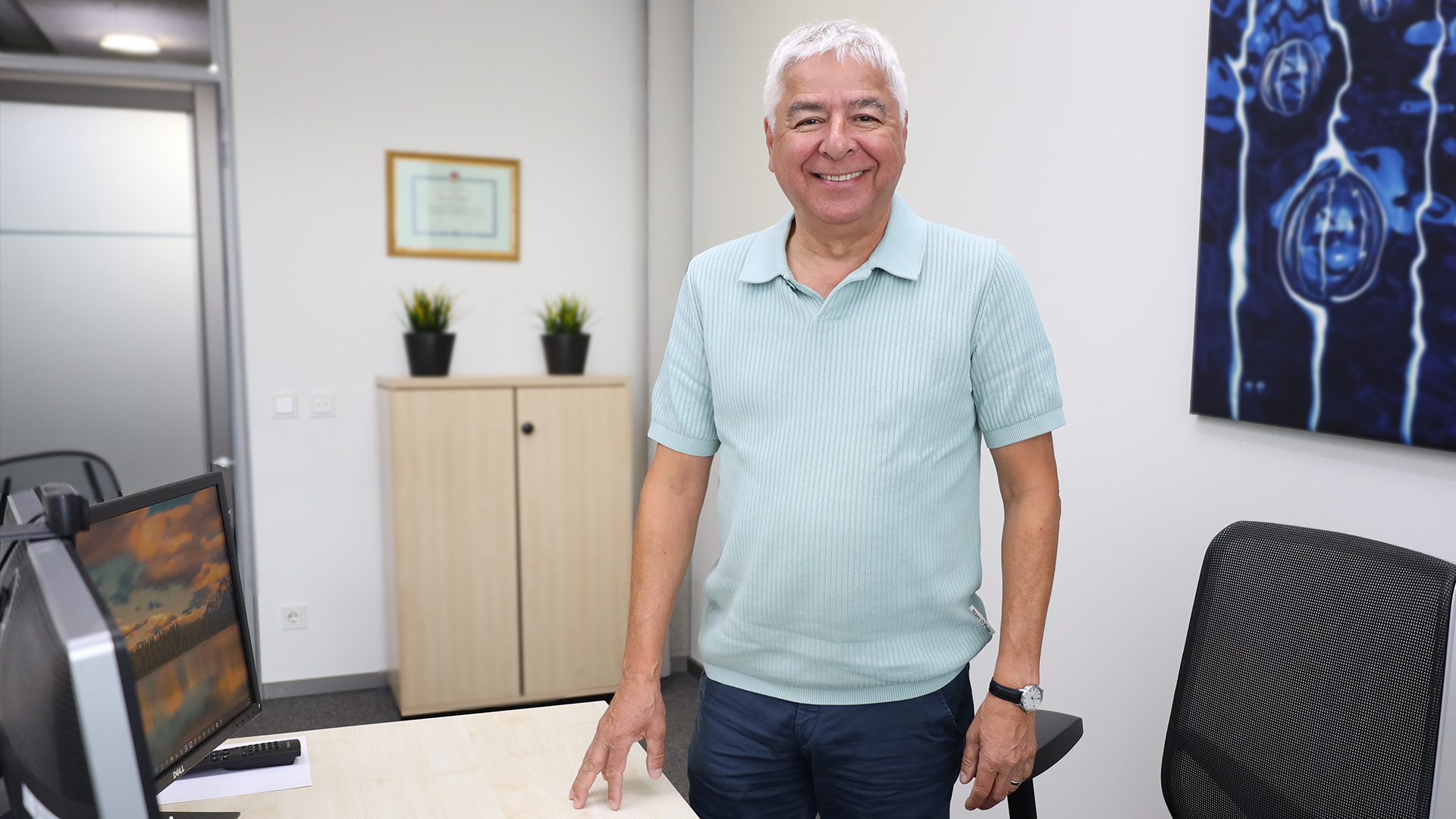


Looking back after a quarter of a century at GFA, Wahby remembers his early days in the Maghreb Department, which he joined as a consultant in fruit and vegetable marketing and market information systems. ‘The first 21 months at GFA were so intense and exciting – most assignments were long ones, taking me to Malta, Albania, Yemen and other countries.’
Wahby moved to GFA from the German Development Service (DED) in 2001, joining as a consultant with a background in agricultural economics – a profile typical of GFA recruits at the time. His doctoral thesis, written in Berlin, focused on modelling the effects of agricultural price policies on soil erosion in a coffee-growing region of Kenya.
For Wahby, a particular career highlight was a rural development project in Vietnam in 2003, which aimed to integrate ethnic minority groups into the country’s dynamic economic development processes. ‘It was politically highly sensitive – we had to tread very carefully between the various interest groups and potential fault lines,’ recalls Wahby, who led the project on the ground in the Vietnamese province of Dak Lak for five and a half years.
After returning from Vietnam to GFA’s Hamburg headquarters, he was appointed head of the Maghreb & Middle East Department within the company’s regional structure at the time. ‘Back then, we focused strategically on the EU as a client – with new projects on TVET in Egypt and Turkey and on Public Administration Reform in Morocco just getting underway when I arrived.’
The merger of the Maghreb & Middle East Department with the Europe Department in 2011 was a milestone. The new EMENA (Europe, Middle East and North Africa) Department aligned and intensified its work on EU-funded projects across the entire region of the EU Neighbourhood and Accession Countries. For Wahby, it was an exciting challenge to lead a now much larger team and getting to grips with entirely new culture in Eastern Europe and the Western Balkans. ‘We were a great team, motivated by the high professional demands of our projects, and we had our share of success too.’ The EMENA Department gradually became one of GFA’s larger departments, as the organisation grew to become a leading consultancy for EU-funded development cooperation.
As the number of projects grew, so did the challenges. The Arab Spring and its repercussions occurred during this period. As head of the EMENA Department, Wahby was also responsible for the coordination with GFA’s subsidiaries: Thalys Conseil in Morocco, where he served as Managing Director from 2012 to 2018, and GFA South East Europe, founded in Belgrade, Serbia, in 2013. From 2011 to 2018, he represented GFA in the German Agribusiness Alliance, a working group affiliated to the German Eastern Business Association and closely related to the Bilateral Cooperation Programme of the then German Ministry of Food and Agriculture, for which GFA acts as general management agent since 1993.
When GFA restructured from regional to technical departments, Wahby was appointed head of GFA’s Climate & Energy Cluster. This internal think-tank and incubator fosters collaboration across GFA companies and departments, delivering targeted services in climate change mitigation and adaptation. ‘By then, it was clear to everyone that climate change was among the greatest threats facing the world. The aim was to position GFA as a competent and reliable partner in climate-related international development cooperation.’
Climate and energy subsequently became increasingly central to Wahby’s work. From its foundation in 2018, he served as a Co-Managing Director of GFA Climate and Infrastructure, a subsidiary of GFA Consulting Group. This subsidiary focused on blended climate finance with private and concessional funding for sustainable infrastructure – particularly for water, solid waste, and renewable energy. Wahby joined the GFA GROUP member HEAT, with its focus on climate policy, heating and cooling, and sustainable buildings as Co-Managing Director in 2019. He helped found and manage H2 Global Advisory GmbH in 2023, which introduced an innovative and highly successful mechanism to stimulate the green hydrogen market. From 2018, he also led GFA’s Sustainability Management. ‘For me, as for most of our colleagues here at GFA, this is central to everything we do,’ says Wahby. He believes GFA is in a strong position, with a sustainability strategy built around climate, people and governance, and a unique company culture.
Appointed to the newly created role of Head of Shareholding Management in 2024, he turned his attention to the reorganisation of GFA GROUP, coordinating overarching strategic and administrative processes. The reorganisation aimed to encourage closer collaboration, greater synergies, and more targeted marketing across the group.
‘We’ve come a long way in just a few years,’ says Wahby. The companies are already collaborating on a sizeable number of projects, he notes, adding: ‘The wide range of expertise across the group will also make it easier for us to diversify our client base in the future.’ He was a driving force behind the reorganisation of GFA GROUP, overseeing the change processes – including the successful integration of GKW Consult, which joined GFA GROUP in 2023.
Despite officially retiring at the end of July, Wahby will not be leaving GFA GROUP entirely. He will stay on in a advisory capacity to take on specific assignments for the group. His position as Head of Shareholding Management will not be filled. ‘Most of my tasks have been completed, and the remaining responsibilities are structured so that they can be handled within the existing group management structure,’ says Wahby.
As he steps down from his official roles, Wahby’s outlook is optimistic. ‘GFA has always been agile and flexible, with the courage to innovate – that is its strength. The pace of our work and the geopolitical challenges facing international cooperation are growing – but if anyone can navigate this well, it is GFA.’


 info@gfa-holding.de
 + 49 40 603 061 00